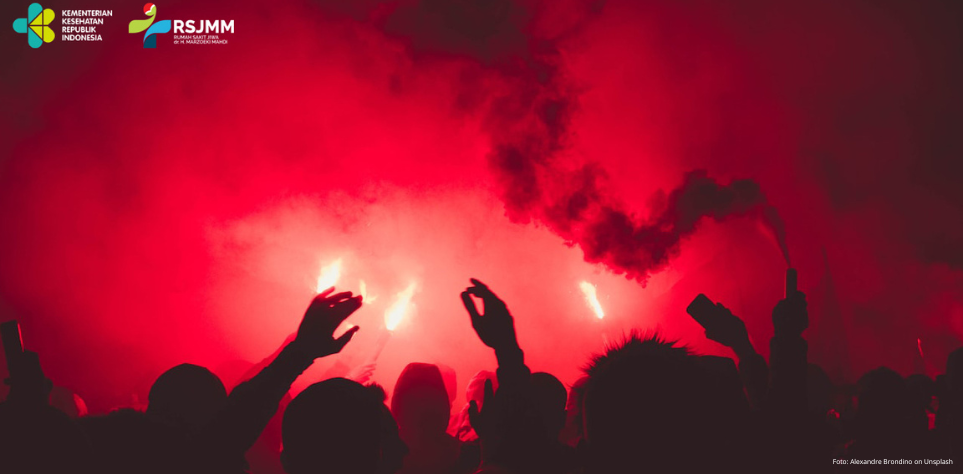
Fanaticism, Violence, and Sports: A Psychological Review of the Kanjuruhan Tragedy
Team Identification is when a fan truly identifies himself or herself as part of the club he supports. It is the same when a person identifies his nation, his tribe, his religion, etc. This team identification describes how relevant a person is to the club, its players, the team's performances and even the attitudes of other players and fans. This deep psychological process of identification leads to excessive fanaticism, there is self-esteem pinned there so that whatever happens to his team will affect his self-esteem, thoughts, emotions and behavior. If there is a bad result achieved by his team or there is a bad team situation then it is perceived as a threat to his self-esteem.
This threat to self-esteem triggers a primitive natural mechanism called fight or flight. This mechanism is characterized by various biological and psychological processes in the body, including:
· Out hormones that trigger sympathetic nerve cells to work that keep a person in a state of alert
· Heart rate increases so it pumps blood faster to all parts of the body
· Blood pressure increases as a result of an increased heart rate making it easy to become emotional
· The respiratory rate increases, fast and short so that oxygen entering the brain becomes reduced and can cause the brain to lack oxygen so that hypoxia occurs
· The muscles contract, tense and agitated
· The perception of pain becomes reduced, the pain is slightly less felt
· The brain's ability to consider something decreases, making it difficult to calculate the profit and loss of an action
This fight or flight condition if not properly regulated will cause negative consequences such as violent behavior which manifests in:
· Verbal abuse
· Physical violence against objects
· Physical self-abuse
· Physical violence against others
This can trigger reactive actions from other parties that lead to uncontrollable circumstances such as the heartbreaking events we witnessed some time ago.
Tips to Reduce Excessive Fanaticism
1. Realize that in competitions there are wins and losses at odds of 50/50, so it is necessary to be prepared to win as well as lose. It is just a game
2. Be a smart and wise fan, losing 1 game does not describe the overall performance of the team
3. Whatever happens to the supported team does not have to affect our self-esteem and life
4. Exercise in regulating emotions by doing deep breaths, relaxation, grounding techniques, humor, etc
5. Try to express emotions in a more positive way, shouting chants, yelling yelling, entertaining attractive movements
6. Avoid harmful and provoking behavior such as vilifying the opposing team, throwing, taking to the field, damaging, injuring because it will create a riotous atmosphere
7. Carry out positive club activities outside the match schedule so that the attributes of the supported club are not only about the results of matches, for example: fan meetings, charity, social services, etc.
Preparation, security and supervision of humane matches need to be continuously put forward so that watching a match can be a healthy part of our mentality.
Sorry for the incident at Kanjuruhan Stadium, keep the spirit of building a great competition in our beloved country.
Author: dr. Lahargo Kembaren, Sp.KJ
Referensi :
Fisher, R.J. & Wakefield, K. (1998). Factors leading to group identification: A field study of winners and losers. Psychology & Marketing, 15, 23-40.
Hirt, E.R., Zillmann, D., Erickson, G.A., & Kennedy, C. (1992). Costs and benefits of allegiance: Changes in fans’ selfascribed competencies after team victory versus defeat. Journal of Personality and Social Psychology, 63, 724-738.
Lindstrom, W.A., & Lease, A.M. (2005). The role of athlete as contributor to peer status in school-age and adolescent females in the United States: From pre-title IX to 2000 and beyond. Social Psychology of Education, 8, 223-244.
Wann, D.L. (2006). Examining the potential causal relationship between sport team identification and psychological wellbeing. Journal of Sport Behavior, 29, 79-95.
Wann, D.L., & Grieve, F.G. (2005). Biased Evaluations of In-Group and Out-Group Spectator Behavior at Sporting Events: The Importance of Team Identification and Threats to Social Identity. Journal of Social Psychology, 145, 531-545.