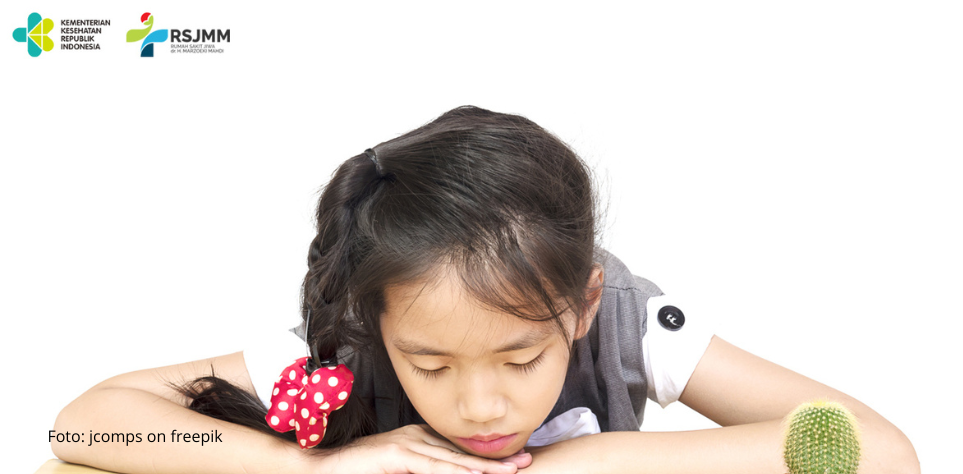
Depression in Children is Increasing
The pandemic situation of the last two years has brought about many changes in the lives of every child that are not easy to navigate. There are many triggers for the emergence of mental health problems in children, including:
- Distance learning
- Not being able to play and gather with friends and family
- Having to stay at home
- Excessive use of gadgets
- Disturbing, threatening, and uncertain news
- Difficulty adapting to returning to school
- Bullying
- Heavy school workload
- Unpleasant home situations, and so on.
All of these factors create psychosocial stressors for children that can lead to the onset of depression.
As parents, we naturally pay great attention to a child's physical health, taking them to the doctor and providing medication when they are sick with conditions like fever, cough, vomiting, and so on. But do we also care about a child's mental health?
A child's mental health is just as important as their physical health. Depression in children often hides its symptoms. Let's try to recognize it and take preventive and therapeutic measures.
According to the DSM-5 (Diagnostic and Statistical Manual for Mental Disorders), depression in children exhibits symptoms such as:
- Sad or easily irritable mood
- Decreased interest, difficulty enjoying daily activities
- Decreased concentration and difficulty making decisions
- Insomnia (difficulty sleeping) or hypersomnia (excessive sleeping)
- Changes in appetite or weight
- Excessive fatigue, easily getting tired, reduced energy
- Feelings of worthlessness or excessive guilt
- Repeated thoughts of death or suicidal ideation
- Psychomotor agitation (restlessness) or psychomotor retardation (sluggishness)
These symptoms persist for two consecutive weeks and disrupt daily functioning at school, in social environments, and within the family.
When symptoms of depression in a child appear, consult a mental health professional such as a psychiatrist, psychiatric nurse, psychologist, or trained general practitioner for prompt assistance.
Depression in children can be prevented by adopting appropriate parenting principles to support a child's mental well-being.
The parenting principles that can be applied to prevent depression in children include:
- LOVE: Provide love, care, and attention to the child, ensuring that we are always there for them.
- CONVERSATION: Encourage the child to talk about their experiences, ensuring they feel comfortable and free to express themselves.
- LISTEN: Make sure we listen to what the child is saying, truly listening, rather than rushing to advise or judge.
- FEELING: Discover what the child is feeling and validate those feelings.
- SYMPTOMS: Recognize signs and symptoms of depression that may emerge.
- BEHAVIOR: Be alert to various changes in the child's behavior.
- PATIENCE: Be patient when dealing with the child, avoiding undue pressure.
- EDUCATE: Convey to the child the importance of mental health.
- COPING: Assist the child in learning effective coping skills to deal with stress, such as relaxation techniques.
- REST TIME: Ensure the child has adequate rest and sleep.
- PROBLEM SOLVING: Help the child find effective and realistic problem-solving strategies.
- ENVIRONMENT: Create a conducive and supportive environment for the child's mental development.
- SUPPORT: Regularly provide support, motivation, and praise to the child.
- EXERCISE: Ensure the child engages in regular physical activity to maintain both physical and mental health.
- BE PROUD: Always let the child know that we are proud of them; this is important for building self-esteem and self-confidence.
- HELP: Seek professional help when needed.
"Train up a child in the way he should go, and when he is old, he will not depart from it." (Proverb)
A child's mental health is far more important than their school grades. Let's allocate more time for our children because they need it!
Author: dr. Lahargo Kembaren, Sp.KJ
Refrences:
1. American Psychiatric Association (2014). Manual Diagnóstico y Estadístico de los Trastornos Mentales (DSM-5) [Diagnostic and Statistical Manual of Mental Disorders (DSM−5)]. Madrid: Médica Panamericana.
2. American Psychological Association Society of Clinical Psychology (APA). (2017). Depression. Available online at: https://www.div12.org/psychological-treatments/disorders/depression/
3. Angold, A., and Costello, E. J. (1995). A test-retest reliability study of child-reported psychiatric symptoms and diagnoses using the Child and Adolescent Psychiatric Assessment (CAPA-C). Psychol. Med. 25, 755–762.