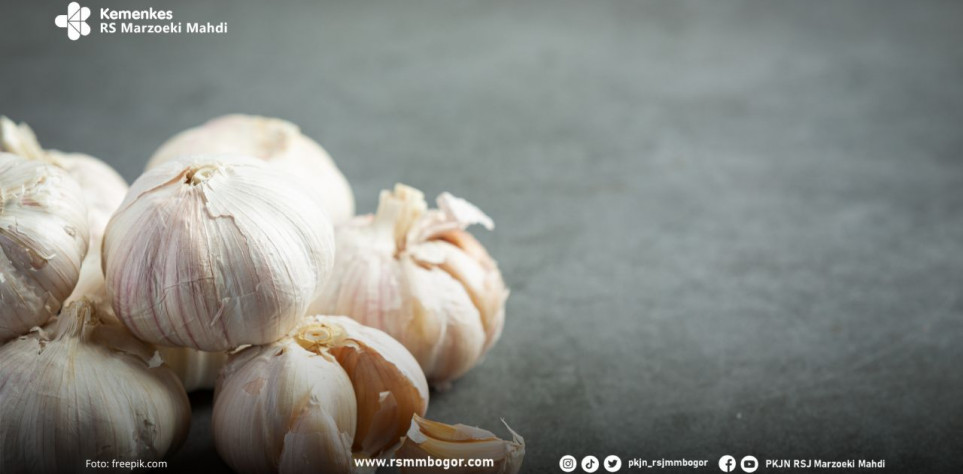
Benefits of Garlic for Health
Garlic (Allium Sativum L.) is one of the spices used for medicine and food ingredients. The benefits of garlic are both in traditional and modern medicine.
Garlic contains several compounds including: allicin, ajoene, and saponins, which have various pharmacological effects. According to (Greef et al., 2020) garlic has the potential to lower blood pressure, cholesterol, sugar, and lipids.
Consumption of garlic can improve health, such as cancer, cardiovascular and metabolic disorders, blood pressure, and diabetes, due to its antioxidant, anti-inflammatory, and lipid-lowering properties (Ansary et al., 2020).
According to (Netzel, 2020) garlic has many biological properties, including antimicrobial activity, nerve and kidney protection, and its bioactive components can be changed through post-harvest treatment, storage, and processing.
Garlic has many benefits both as a traditional medicine and pharmacology. Garlic and its organosulfur compounds also have antiviral activity that can be used as a prophylaxis in preventing viral infections by increasing the immune response (Rouf et al., 2020).
Benefits of Garlic for Children
Garlic has benefits not only for adults, but also for children. According to (Sani et al., 2006) Oral garlic can improve oxygenation and improve dyspnea in children with hepatopulmonary syndrome.
According to (McCrindle et al., 1998) that garlic extract therapy has no significant effect on cardiovascular risk factors in pediatric patients with familial hyperlipidemia.
Although many health benefits are associated with garlic, it is important to note that some people may experience allergic reactions or gastrointestinal irritation with large amounts of garlic consumption. Consuming garlic must also be adjusted to individual conditions and consulted with a health professional to ensure optimal benefits and reduce the risk of side effects.
Literature Reference:
Greef, D., Barton, E., Sandberg, E., Croley, C., Pumarol, J., Wong, T., Das, N., & Bishayee, A. (2020). Anticancer potential of garlic and its bioactive constituents: A systematic and comprehensive review. Seminars in cancer biology. https://doi.org/10.1016/j.semcancer.2020.11.020.
Ansary, J., Forbes-Hernández, T., Gil, E., Cianciosi, D., Zhang, J., Elexpuru-Zabaleta, M., Simal-Gándara, J., Giampieri, F., & Battino, M. (2020). Potential Health Benefits of Garlic Based on Human Intervention Studies: A Brief Overview. Antioxidants, 9. https://doi.org/10.3390/antiox9070619.
Netzel, M. (2020). Garlic: Much More Than a Common Spice. Foods, 9. https://doi.org/10.3390/foods9111544.
Rouf, R., Uddin, S., Sarker, D., Islam, M., Ali, E., Shilpi, J., Nahar, L., Tiralongo, E., & Sarker, S. (2020). Antiviral potential of garlic (Allium sativum) and its organosulfur compounds: A systematic update of pre-clinical and clinical data. Trends in Food Science & Technology, 104, 219 - 234. https://doi.org/10.1016/j.tifs.2020.08.006.
McCrindle, B., Helden, E., & Conner, W. (1998). Garlic extract therapy in children with hypercholesterolemia. Archives of pediatrics & adolescent medicine, 152 11, 1089-94 . https://doi.org/10.1001/ARCHPEDI.152.11.1089. Top of Form